
Ben Vogel · 7 October 2026
Investigating How Specialized Coatings Alter Light Scatter Dynamics Within Oversized Visual Arrays for Data Visualization Labs
Specialized coatings modify light scatter patterns across oversized visual arrays that support data visualization in research facilities, and these modifications occur through precise changes in surface refractive indices and micro-scale textures that redirect photons away from unwanted directions. Researchers apply these coatings to reduce glare while preserving color fidelity in environments where multiple viewers examine complex datasets simultaneously, and the process involves layering dielectric materials that interact with incoming light at specific wavelengths.
Fundamentals of Light Scatter in Large Display Systems
Light scatter arises when photons encounter surface irregularities on expansive screen setups, and this phenomenon intensifies in oversized arrays because the cumulative effect of minor imperfections becomes visible across wider fields of view. Data indicates that scatter angles increase proportionally with array size, according to measurements taken at facilities equipped with high-resolution sensors. Studies from the Australian National University show that uncoated surfaces can redirect up to 15 percent of incident light into diffuse patterns that degrade image clarity during prolonged sessions.
Coatings engineered for these arrays incorporate anti-reflective nanoparticles that align to suppress forward scatter while allowing controlled diffusion in designated zones. Technicians measure the resulting changes using goniophotometers that capture angular distributions before and after application, and the data reveals consistent reductions in haze values when coating thickness stays within 200 to 400 nanometers.
Coating Materials and Their Optical Properties
Common materials include silicon dioxide blends combined with titanium oxide variants that create graded index profiles, and these profiles minimize abrupt refractive shifts that trigger scatter. Manufacturers test durability under continuous illumination because data visualization labs often operate equipment around the clock. In October 2026 researchers at the National Research Council Canada published results demonstrating that fluoropolymer-infused coatings maintained scatter reduction performance for over 18 months under typical lab lighting conditions.
Application methods range from vacuum deposition for uniform coverage to spray techniques that allow selective treatment on curved sections of oversized arrays. Each method produces distinct scatter signatures, with vacuum processes yielding smoother surfaces that limit wide-angle diffusion. Observers note that hybrid approaches combining both techniques deliver balanced performance when arrays exceed five meters in width.
Measurement Protocols Used in Laboratory Settings
Teams employ integrating spheres alongside spectrometers to quantify total integrated scatter, and they record spectral reflectance curves across visible and near-infrared ranges. These protocols follow guidelines established by standards organizations that specify calibration routines using traceable reference samples. Data collected over multiple sessions shows that coated arrays exhibit scatter reductions between 40 and 65 percent compared with untreated panels, depending on coating formulation and substrate type.
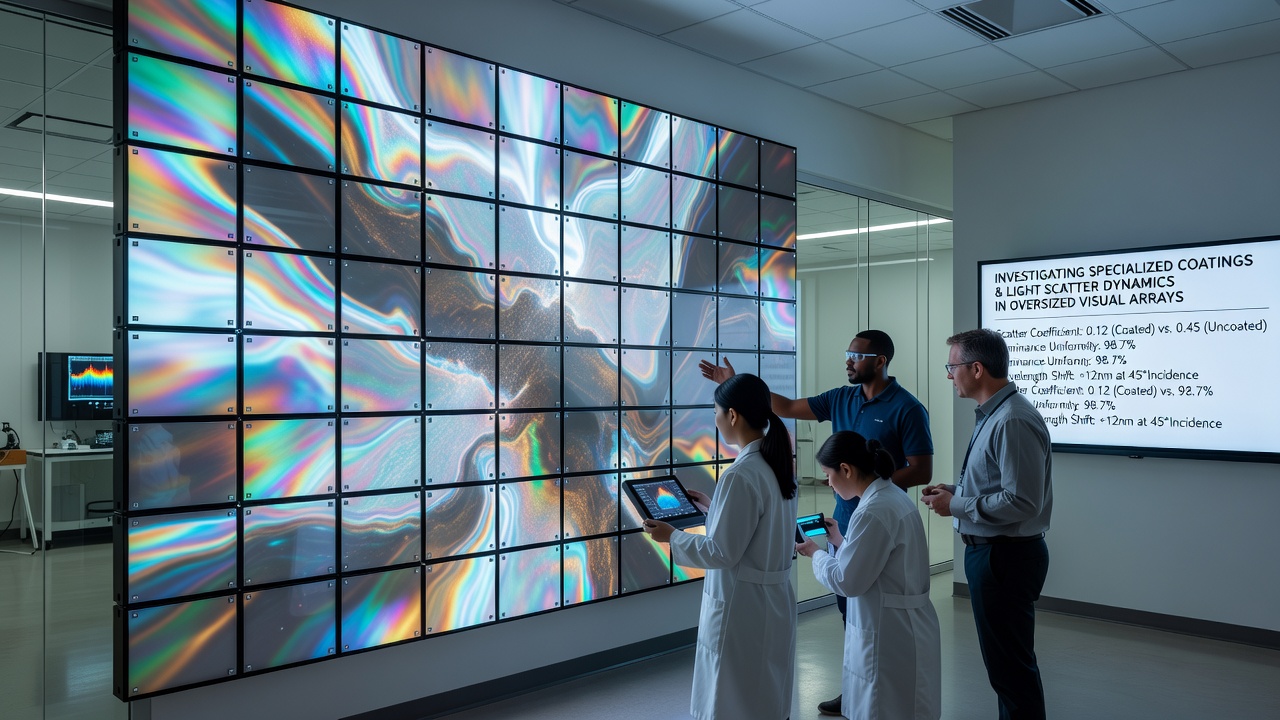
Calibration routines include regular checks against reference standards maintained by the National Institute of Standards and Technology, and these checks ensure measurement repeatability across different facilities. Researchers cross-verify results using computational models that simulate ray paths through layered media, and the models help predict performance before physical application occurs.
Integration Challenges in Operational Labs
Installing coated arrays requires precise alignment to avoid introducing new scatter sources at panel seams, and misalignment can offset the benefits gained from the coatings themselves. Environmental factors such as humidity fluctuations and airborne particulates further influence long-term scatter behavior, prompting labs to implement controlled atmospheres around critical display zones. Maintenance schedules incorporate periodic scatter audits that track performance drift over time.
Software tools compensate for residual scatter by adjusting pixel output values in real time, yet these adjustments increase computational load on rendering systems. Facilities that combine hardware coatings with software corrections report improved consistency in data presentation across varying ambient conditions.
Conclusion
Specialized coatings continue to shape light management strategies in data visualization laboratories that rely on oversized arrays, and ongoing measurements document their effects on scatter dynamics with increasing precision. Research institutions across multiple regions contribute data that supports iterative improvements in coating formulations and application techniques. The accumulated evidence guides future development of arrays designed for sustained clarity under demanding operational requirements.